
There’s a question we’re getting from almost every small business owner we talk to right now: “Should I just use AI to write my website content and blog posts?”
It’s a fair question. AI writing tools are fast, cheap, and everywhere. But at Sprout Media Lab, we’ve seen firsthand what happens when businesses go all-in on AI content without a strategy behind it – and the results are rarely pretty. This post cuts through the noise with what the data actually says and what it means for your business.
What Google Actually Says
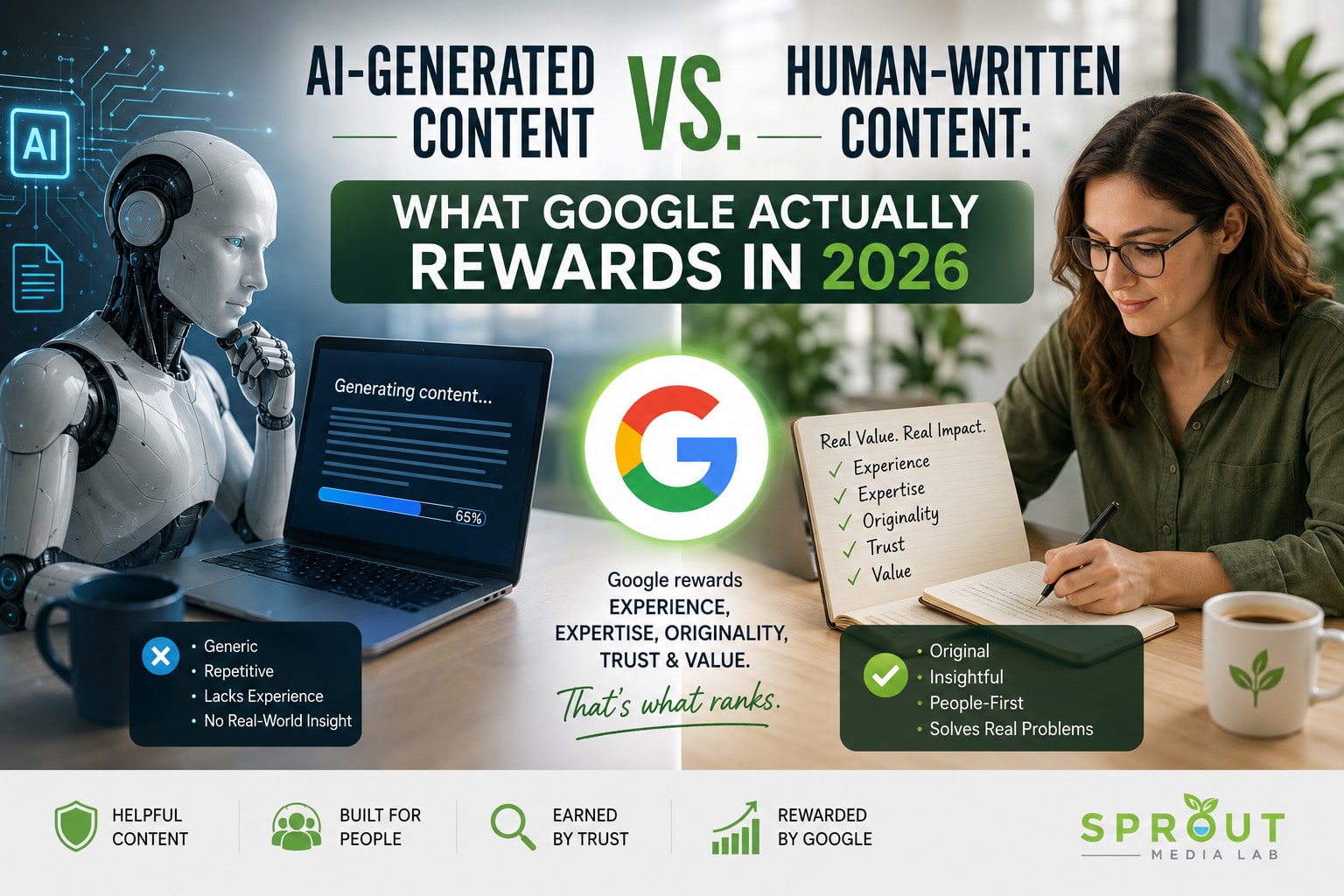
Google does not automatically penalize AI-generated content. Their position has been consistent since 2023: content quality, helpfulness, and trustworthiness matter – not whether a human or machine wrote the first draft.
What Google does penalize is content that is thin, generic, or produced primarily to manipulate rankings. That applies equally to human and AI content.
So the real question was never “AI or human?” It’s always been: does this content genuinely help the person reading it?
What the Data Shows
The official Google position is one thing. The data tells a more specific story.
A Semrush analysis of 42,000 blog posts found that human-written content appears in the #1 Google position 80% of the time – compared to just 9% for purely AI-generated pages. Human content was 8 times more likely to rank #1 than pure AI content.
A separate 16-month study tracking 4,200 articles found that unedited AI content ranked 23% lower on average than human-written articles targeting the same keywords – with the gap widening after Google’s March 2026 core updates.
But here’s where it gets interesting: AI-assisted content with substantive human editing performed within 4% of fully human-written content. The real variable isn’t who wrote it… it’s the quality of editorial judgment applied before publishing.
The other major disadvantage of pure AI content: it acquired 61% fewer backlinks than human-written articles on comparable topics. Backlinks remain a top-three ranking signal. That gap is damaging and hard to recover from.
Why AI Alone Can’t Clear Google’s Bar: E-E-A-T
Google evaluates every piece of content through a framework called E-E-A-T: Experience, Expertise, Authoritativeness, and Trustworthiness. It’s the single most important quality framework in search right now – and it’s the exact reason raw AI content consistently underperforms.
Experience is the newest and most important element. Google wants content written by someone who has actually done the thing they’re writing about. An AI tool has never built a deck, cleaned a driveway, or installed a garage door. It can describe the process – but it cannot speak from experience. Google’s systems are increasingly good at detecting that gap.
Expertise is depth of knowledge. Generic AI content describes what everyone already knows. Expert content adds something new – a nuance, an insight, a real-world observation that only comes from doing the work.
Authoritativeness is reputation – whether others in your industry recognize you as a credible source. Authority compounds over time and becomes one of the strongest long-term ranking signals.
Trustworthiness is the foundation everything else sits on. For local businesses specifically, Google Business Profile reviews, consistent directory listings, and local citations all feed directly into trust signals that influence local rankings.
The bottom line: AI can help with the mechanics of writing. It cannot manufacture Experience, Expertise, Authoritativeness, or Trust. Those come from a real business built by real people over real time – and that’s exactly what Sprout helps our clients demonstrate through their content.
The Approach That Actually Works: AI-Assisted, Human-Led
Sprout uses AI tools as part of our content workflow – we’re transparent about that. But there’s a significant difference between using AI as a tool and using AI as a replacement for strategy and expertise.
The hybrid model that consistently outperforms both pure AI and slow all-human production looks like this:
Strategy first. Every piece of content starts with a human decision – what to write, who it’s for, what it needs to accomplish. AI doesn’t make that call.
AI-assisted drafting. For research, outlines, and structural first drafts, AI tools add genuine speed and scale. That efficiency gets passed directly to our clients.
Expert human enrichment. This is the step that separates content that ranks from content that doesn’t. Real project examples, local market knowledge, original insights, and the brand voice that makes content sound like the business… not a machine. This is what Sprout’s content team adds to every piece we produce.
Editorial quality control. Every piece is reviewed for accuracy, E-E-A-T signals, and search optimization before it’s published. Non-negotiable.
This isn’t the “hit generate and post” approach that produces the 23% ranking gap. It’s the process that delivers content Google trusts, readers engage with, and competitors can’t easily replicate.
And the Verdict Is…
Pure, unedited AI content consistently underperforms – especially at the top positions where leads actually come from. But AI-assisted content with expert human oversight performs nearly as well as fully human-written content, at a fraction of the time and cost.
The businesses winning the content game in 2026 are using AI as a tool, not a strategy. They’re pairing it with real expertise, real local knowledge, and a real editorial process – which is exactly what Sprout Media Lab provides.
The internet is filling up with generic, indistinguishable AI content. The opportunity for small businesses that invest in doing it right has never been greater.
Ready to build a content strategy that actually ranks and converts?