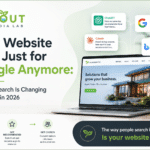

For more than two decades, businesses have built websites around one primary objective: show up on Google.
Choose the right keywords. Optimize your pages. Build authority. Rank higher. Get the click.
That strategy still matters – but the search landscape has fundamentally changed.
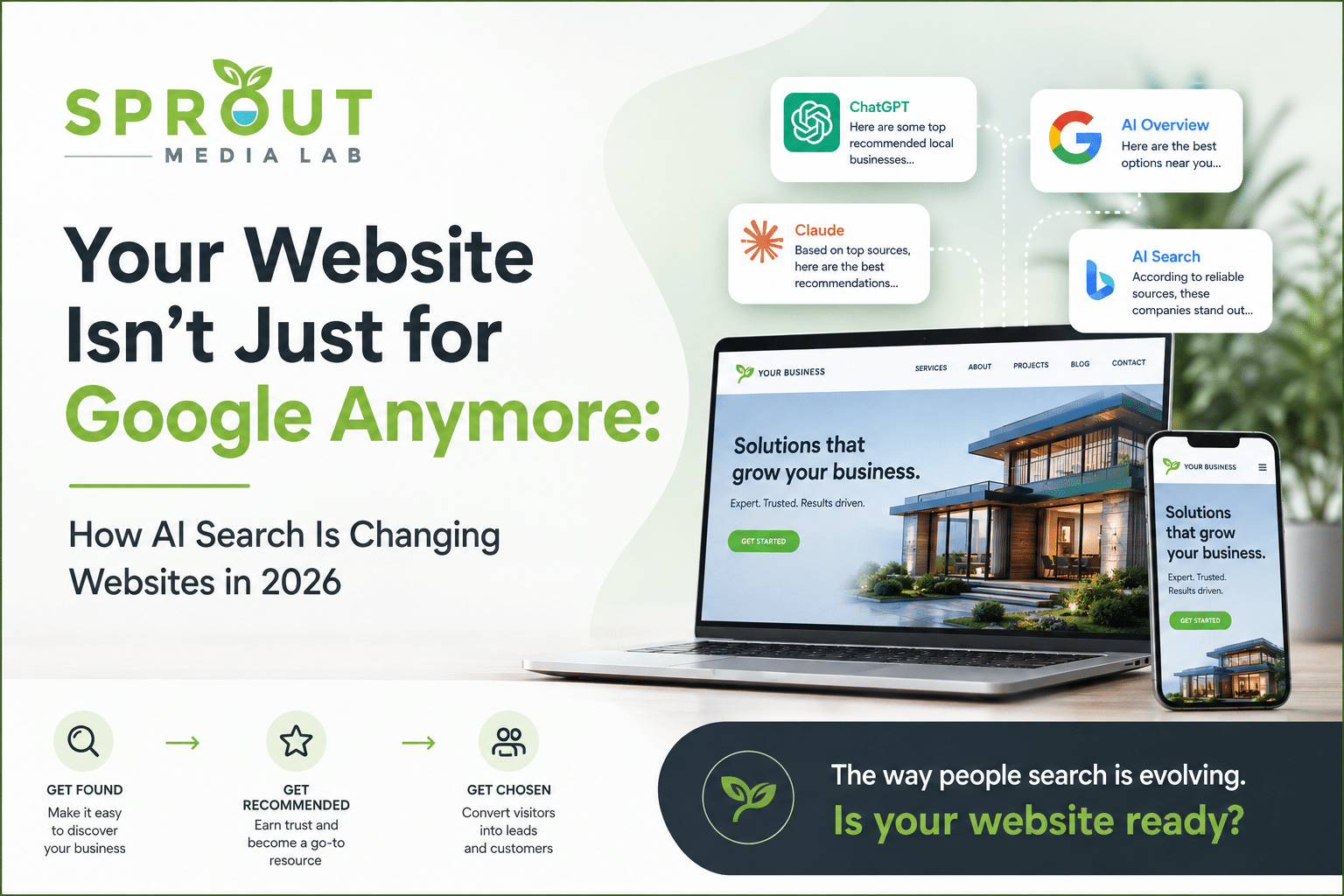
Today, your potential customers aren’t only searching Google and scrolling through a traditional list of websites. They’re asking questions directly inside ChatGPT, Google AI Overviews, Google AI Mode, Claude, and other AI-powered platforms.
Instead of searching:
“best landscaping company near me”
someone might ask:
“Who are the best landscaping companies near me for a complete backyard renovation, including a patio, outdoor kitchen and landscape design?”
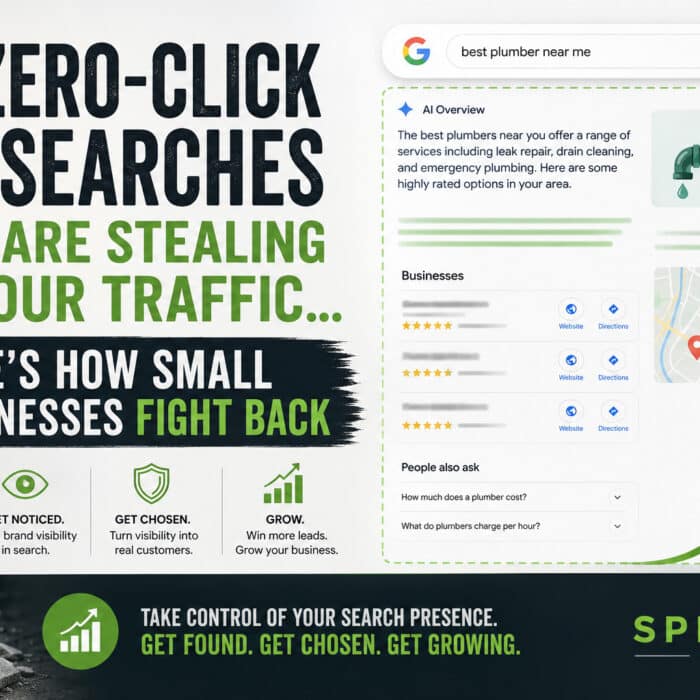
Rather than receiving ten blue links, they may receive an AI-generated response that summarizes their options, compares businesses and points them toward a handful of sources.
That creates an entirely new challenge for businesses:
Your website doesn’t just need to rank anymore. It needs to be understood, trusted, referenced – and ultimately chosen.
Welcome to search in 2026 and beyond.
Search Is Moving From Keywords to Conversations
Traditional search was largely built around keywords.
A homeowner might search:
- landscape contractor Daytona Beach
- personal injury attorney Raleigh
- commercial pressure washing Jacksonville
- health insurance for small business
- pool builder near me
Businesses created pages targeting those searches, and Google attempted to determine which pages deserved the highest rankings.
AI search is changing that interaction.
People can now describe exactly what they’re looking for in natural language.
They can ask:
“What should I look for when hiring a company to build an outdoor living space in Florida?”
Then follow it with:
“Which companies near me specialize in high-end projects?”
And then:
“Compare the top three and tell me which one looks like the best fit for a $150,000 project.”
The search process has become a conversation rather than a series of isolated keyword searches.
ChatGPT, for example, can search the web and provide answers with citations and links to relevant sources. OpenAI says websites can be eligible to appear in ChatGPT Search when its search crawler can access them, although inclusion and placement are never guaranteed.
Google is moving in a similar direction. AI Overviews can summarize information directly within search results, while AI Mode is designed for more complex questions, comparisons and follow-up exploration.
Claude can also search across multiple web sources and return conversational answers with citations and links.
The result is an increasingly fragmented search journey.
Your next customer might discover your company through Google.
Or ChatGPT.
Or an AI Overview.
Or Google AI Mode.
Or Claude.
And increasingly, they may interact with AI before they ever visit your website.
The Goal Is No Longer Just “Rank #1”
For years, SEO success was relatively easy to visualize.
You wanted your website near the top of Google for your most important keywords.
That still has tremendous value.
But businesses now need to think beyond rankings.
The new objective is:
Get Found → Get Recommended → Get Chosen
Get Found
Search engines and AI platforms need to discover and understand your website.
Get Recommended
Your company needs enough relevance, authority, clarity and trust for search and AI systems to reference or surface it when appropriate.
Get Chosen
When someone finally reaches your website, it needs to convince them that you’re the right company to contact.
This is where traditional SEO, AI search optimization and conversion-focused website design begin to overlap.
What Does Your Website Need to Succeed in AI Search?
There isn’t a magic piece of “AI schema,” secret prompt or button you can add to your website that suddenly makes ChatGPT or Google recommend your business.
In fact, Google explicitly says that its existing SEO best practices remain foundational for appearing in AI Overviews and AI Mode and that there are no special additional technical requirements for inclusion.
What is changing is the importance of making your business and its expertise extremely easy to understand.
Here are several areas businesses should be paying close attention to.
Clearly Explain What You Do
AI shouldn’t have to guess what your business does.
Your website should clearly communicate:
Who you are.
What you do.
Who you serve.
Where you serve them.
What you specialize in.
Why someone should choose you.
Generic marketing language makes this harder.
Compare:
“We provide innovative solutions and exceptional customer service.”
with:
“We design and build custom outdoor living spaces for homeowners throughout Central Florida, including pools, patios, outdoor kitchens, pergolas and complete backyard renovations.”
The second version gives both people and machines far more useful information.
Clarity is becoming a competitive advantage.
Build Depth Around Your Areas of Expertise
Having one page that briefly lists 15 services isn’t the same as demonstrating expertise in those services.
If an HVAC contractor wants to become a trusted resource for heat pump installation, for example, its website should probably contain more than:
“We install heat pumps. Call today for a free estimate.”
A stronger website might include:
- A detailed heat pump installation page
- Heat pump repair information
- Cost and pricing guidance
- Heat pump vs. traditional HVAC comparisons
- FAQs
- Information about brands and equipment
- Local climate considerations
- Financing information
- Case studies or completed installations
- Expert advice from the company’s technicians
Collectively, this creates something far more valuable than a keyword-targeted page.
It creates topical authority and useful information around a subject.
Create Content That Actually Answers Customer Questions
This may be one of the biggest opportunities created by AI search.
Think about the questions your salespeople hear every week:
How much does it cost?
How long does it take?
What’s the difference between option A and option B?
Is this worth doing?
What problems should I watch out for?
What should I know before hiring someone?
What’s the best solution for my situation?
Those questions should become part of your website.
AI systems are built around answering questions. The businesses that provide clear, useful and credible answers create more opportunities for their information to become part of those answers.
Google’s 2026 guidance specifically encourages website owners to create valuable, unique, non-commodity content rather than simply producing more generic material.
Show Real Experience, Expertise and Proof
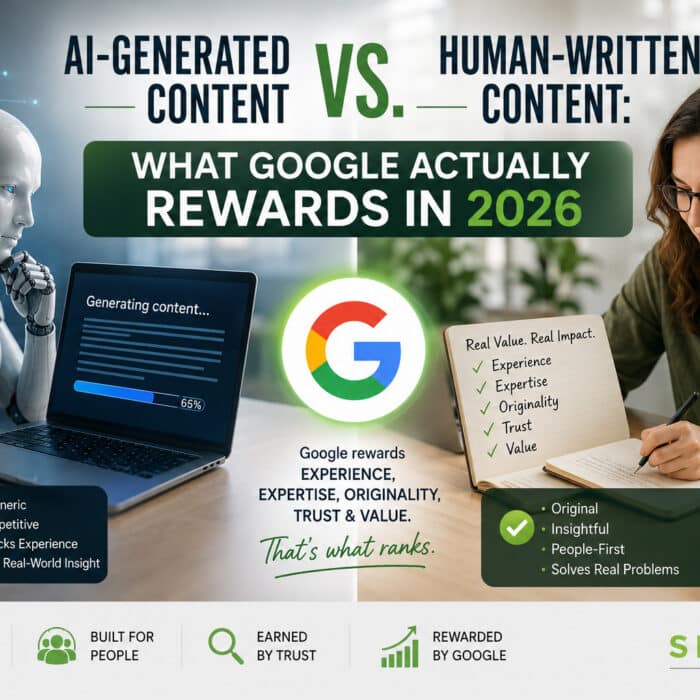
AI has made it incredibly easy to produce generic content.
That means simply publishing more words isn’t necessarily an advantage.
What becomes increasingly valuable is information that only your business can provide.
That might include:
- Original photos
- Completed projects
- Case studies
- Before-and-after examples
- Customer testimonials
- Reviews
- Expert commentary
- Pricing insights
- Common mistakes you’ve encountered
- Your process
- Team credentials
- Years of experience
- Certifications and affiliations
- Original videos
- Data from your own projects or customers
If every competitor publishes essentially the same AI-generated article, there’s very little reason for a search engine – or a potential customer – to view one as more valuable than another.
Google has also warned that generating large numbers of AI-created pages without adding meaningful value can violate its policies against scaled content abuse.
AI should help businesses create better content – not simply more content.
Strengthen Your Business Entity Across the Web
Your website doesn’t exist in a vacuum.
Search engines and AI platforms may encounter information about your company across many sources, including business directories, review sites, social profiles, news articles, industry associations and other websites.
For local businesses, that makes your overall digital footprint increasingly important.
Your business name, services, location, leadership, expertise and reputation should tell a consistent story across the web.
Think of this as building a digital trust ecosystem around your company.
Your website is the center of that ecosystem – but it isn’t the entire ecosystem.
Make Your Website Technically Accessible
Great content isn’t particularly useful if search platforms can’t access it.
Traditional technical SEO fundamentals remain important:
- Crawlability
- Indexability
- Mobile usability
- Page speed
- Logical site architecture
- Internal linking
- Descriptive page titles and headings
- Appropriate structured data
- Accessible text-based content
Google says pages need to be indexed and eligible to appear in traditional Google Search to be eligible as supporting links in AI Overviews and AI Mode.
Businesses interested in visibility through ChatGPT should also make sure they aren’t inadvertently blocking OpenAI’s OAI-SearchBot crawler. OpenAI specifically recommends allowing the crawler if publishers want their content to be discoverable, summarized and cited in ChatGPT Search.
This is why AI visibility isn’t simply a content initiative.
SEO, content, web development and digital PR increasingly need to work together.
Your Website Still Has Another Job: Converting the Visitor
There’s an interesting side effect to AI search.
Someone may already know quite a bit about your company before they reach your website.
AI might have helped them:
- Understand their problem
- Research possible solutions
- Compare providers
- Evaluate costs
- Narrow down their choices
That means some visitors arriving from AI-assisted discovery may be further along in their decision-making process.
Google itself notes that generative AI search creates opportunities to reach users who may be more inclined to engage with a site or convert.
Your website needs to capitalize on that opportunity.
When someone lands on your site, they should quickly understand:
“Yes, these people specialize in exactly what I need.”
Then they need reasons to trust you.
Reviews.
Results.
Experience.
Photos.
Case studies.
Credentials.
Clear differentiators.
And finally, they need an obvious next step:
Request a Quote.
Schedule a Consultation.
Call Now.
Get Your Free Assessment.
Talk to an Expert.
Visibility without conversion is just traffic.
SEO Isn’t Dead. It’s Evolving.
Whenever technology changes search, someone announces that SEO is dead.
It isn’t.
Google’s own guidance is quite clear: foundational SEO best practices remain relevant to its generative AI experiences because those experiences still rely heavily on Google’s core search and quality systems.
But SEO is becoming part of a larger strategy.
Businesses now need to think about:
SEO – Search Engine Optimization
Can Google find, understand and rank your website?
AEO – Answer Engine Optimization
Does your content clearly answer the questions customers are asking?
GEO – Generative Engine Optimization
Does your company and its content have the signals that make it useful and credible within AI-generated answers?
CRO – Conversion Rate Optimization
Once someone reaches your website, does it turn that visitor into a lead or customer?
These aren’t four unrelated marketing tactics.
They’re increasingly pieces of the same customer journey.
The Websites That Win in 2026 Will Be Built Differently
The old model was:
Build Website → Add Keywords → Rank on Google → Get Traffic
The emerging model looks more like:
Build Authority → Answer Questions → Establish Trust → Become Discoverable Across Search & AI → Earn the Visit → Convert the Customer
That requires businesses to rethink their websites.
Not as online brochures.
Not as collections of keyword-targeted pages.
And certainly not as machines for publishing hundreds of generic AI-generated articles.
Your website should become the authoritative digital source of truth about your business and your expertise.
It should clearly communicate what you know, what you do, who you help, where you work, why you’re qualified and why customers choose you.
Is Your Website Ready for the New Era of Search?
The shift toward AI-powered search isn’t something businesses should panic about.
But it also isn’t something they should ignore.
Google is integrating generative AI directly into Search. ChatGPT can search and cite information from the web. Claude can search across sources and provide cited answers. And the ways consumers research companies, products and services continue to evolve.
The businesses positioned to benefit will be the ones that start adapting now.
At Sprout Media Lab, we believe the next generation of digital marketing isn’t about choosing between traditional SEO and AI search.
It’s about building a complete search and conversion strategy designed to help your business:
Get Found. Get Recommended. Get Chosen.
That means combining strong website strategy, traditional SEO, local search optimization, high-quality content, AEO/GEO principles, digital authority and conversion optimization into one cohesive approach.
Because your customers aren’t searching in just one place anymore.
Your website shouldn’t be optimized for just one place either.
Want to Know How AI-Ready Your Website Is?
Request a Website & AI Visibility Assessment from Sprout Media Lab.
We’ll take a look at how your website is positioned for traditional Google Search, AI-powered discovery and – most importantly – turning those visitors into real leads and customers.
Want to Know How AI-Ready Your Website Is?
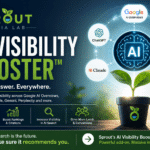
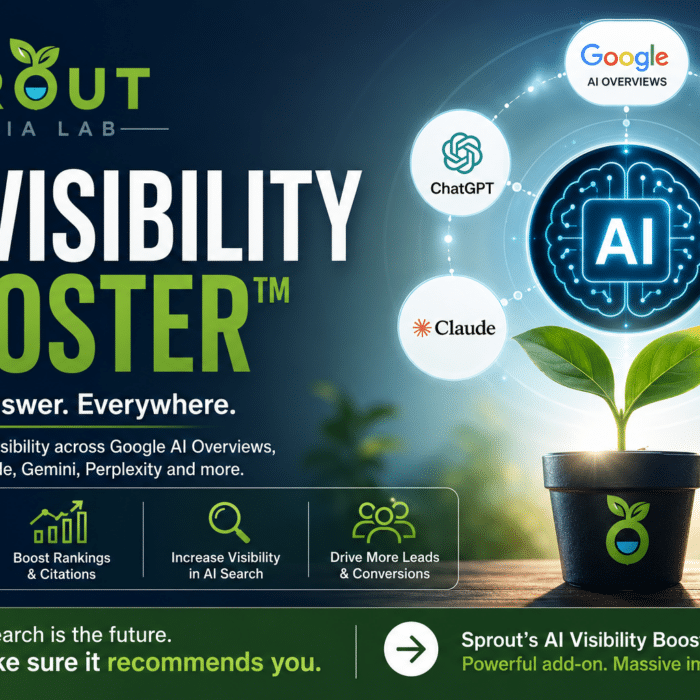
At Sprout Media Lab and SproutScape Marketing, we help Home Service Businesses improve their visibility across:
- Google Search
- Google Maps
- AI Search Engines
- ChatGPT
- Google AI Overviews
- Local Search Results
From Local SEO and Google Business Profile Optimization to AEO and GEO strategies, our team helps businesses position themselves for the future of search.
Contact us today to learn how we can help your business grow online. Schedule a strategy call today Or… Call Us @ (800) 617-6975