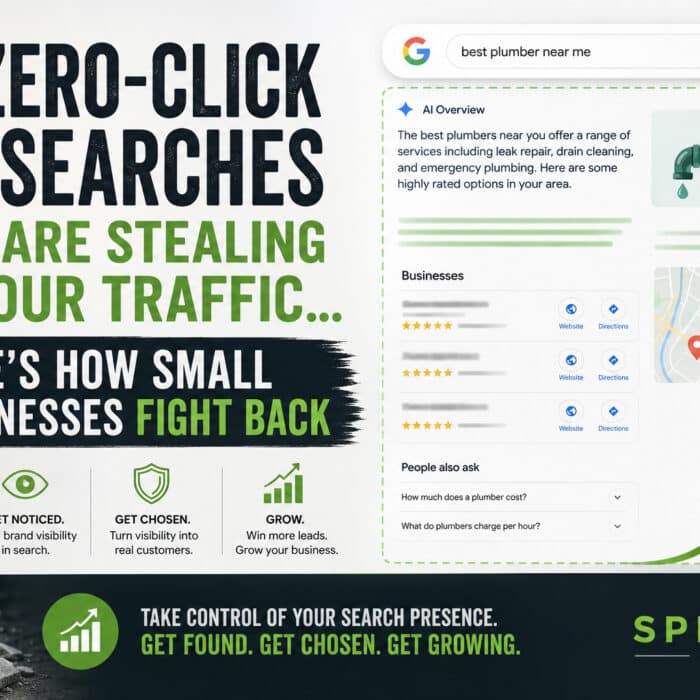


When was the last time your business received a Google review?
If you can’t remember, there’s a good chance your competitors are gaining an advantage.
As 2026 comes to a close, small business owners are evaluating their marketing strategies, reviewing budgets, and planning how to generate more leads in 2027.
But one of the most powerful marketing opportunities might already be sitting right in front of you: your Google reviews.
Today’s consumers aren’t just searching for businesses online. They’re comparing ratings, reading customer experiences, looking at recent feedback, and deciding who they can trust before ever making a phone call.
And with AI-powered search platforms becoming an increasingly important part of how people discover businesses, your online reputation deserves more attention than ever.
The businesses that consistently earn authentic, positive customer reviews may have a significant competitive advantage heading into 2027.
Here’s why – and what you can do about it.
1. Google Reviews Are Often Your First Impression
Think about the last time you searched for a restaurant, contractor, or local service provider.
Chances are, you noticed the star ratings before you clicked on a website.
Your potential customers are doing the same thing.
Imagine searching for a hardwood floor refinishing company and finding these two businesses:
Company A
- 4.9-star Google rating
- 187 customer reviews
- Several new reviews within the past month
- Thoughtful responses from the business owner
Company B
- 4.3-star Google rating
- 24 customer reviews
- Most recent review was eight months ago
- No responses from the business
Which company would you be more inclined to contact?
Even before visiting either website, Company A has likely made a stronger first impression.
That’s the power of online reputation.
Google reviews provide something traditional advertising often struggles to deliver: social proof from real customers.
And when someone is preparing to spend hundreds or thousands of dollars on a service, that trust can make all the difference.
2. Your Google Reviews Can Influence Local Search Visibility
Google reviews aren’t just about building trust. They can also contribute to your visibility in local search results.
Google identifies three primary factors influencing local search rankings:
- Relevance: How closely your business matches what someone is searching for.
- Distance: How far your business is from the searcher or the location specified in the search.
- Prominence: How well-known and established your business appears to be.
According to Google’s own guidance, more reviews and positive ratings can help your business’s local ranking.
That means a strong review profile can support your broader Local SEO strategy, particularly when combined with an optimized Google Business Profile, relevant website content, and consistent business information.
However, reviews alone won’t guarantee a top position in the Google Maps 3-Pack.
The takeaway: Your Google reviews should be treated as an ongoing part of your Local SEO strategy – not simply something you occasionally ask customers to leave.
3. Recent Reviews Matter More Than You Might Think
Having 100 or 200 Google reviews is certainly valuable.
But what if your most recent review was from six months ago?
Now compare that to a competitor receiving several new reviews every week.
Which business appears more active, engaged, and trusted by current customers?
Review recency can influence how consumers perceive your business.
Customers want reassurance that you’re still delivering excellent service today – not just that you delivered it two years ago.
Recent reviews can also provide updated information about your customer experience, services, employees, and completed projects.
For example, a landscaping company with recent reviews mentioning patio installations, landscape lighting, and outdoor living projects gives prospective customers a better understanding of its current capabilities.
While Google doesn’t publicly disclose a precise ranking weight for review recency, maintaining a steady flow of genuine customer feedback is a sensible reputation management practice.
Our recommendation: Focus on generating reviews consistently throughout the year rather than relying on occasional campaigns to collect a large number all at once.
4. Review Quality Is Just as Important as Quantity
Not all reviews provide the same value to prospective customers.
Consider these two examples:
Review A:
“Great company. Highly recommend!”
Review B:
“We hired this company to refinish the hardwood floors throughout our home. The crew arrived on time, protected our furniture, and did an incredible job bringing our 20-year-old floors back to life. The entire project was completed in four days, and the results exceeded our expectations.”
Both are positive reviews.
But Review B provides much more useful information to someone considering a similar project.
It describes the service performed, the customer experience, and the outcome.
Detailed, authentic reviews can help prospective customers understand what makes your company different from competitors.
They also reinforce your business’s expertise and credibility.
You should never script reviews or pressure customers to include specific keywords. Instead, encourage customers to share their genuine experiences in their own words.
The goal isn’t to manufacture perfect reviews.
It’s to build a collection of authentic customer experiences that accurately reflects the quality of your business.
5. Google Reviews Are Becoming More Relevant in the Age of AI Search
 Here’s another reason to pay attention to your online reputation heading into 2027.
Consumers are increasingly exploring businesses through AI-powered search experiences, including ChatGPT and Google’s AI features.
Instead of searching for “pressure washing company near me,” someone might ask:
“Who are the most reputable pressure washing companies in Jacksonville with strong customer reviews?”
Or:
“Can you recommend a highly rated landscaping contractor who specializes in outdoor living spaces?”
AI-powered platforms can help customers research businesses, compare options, and evaluate information from multiple sources.
Online reviews and business reputation information may contribute to these experiences, depending on the platform and the sources it uses.
That doesn’t mean earning more Google reviews will automatically make your company appear in ChatGPT recommendations.
However, maintaining a strong, credible, and consistent online reputation is increasingly valuable as customer discovery expands beyond traditional search engines.
At Sprout Media Lab, we believe businesses should be preparing for both traditional SEO and emerging AI search opportunities.
And building authentic customer trust is an important part of that foundation.
6. Responding to Reviews Shows Customers You’re Paying Attention
Here’s something many business owners overlook.
Getting a Google review is only half the opportunity.
Responding to that review can be just as important for building trust.
When someone leaves a positive review, a thoughtful response demonstrates appreciation and reinforces your commitment to customer service.
When someone leaves a negative review, a professional response shows prospective customers how your business handles concerns.
And remember, your response isn’t just for the person who wrote the review.
It’s also for every potential customer who reads it afterward.
A few best practices:
- Respond to both positive and negative reviews.
- Personalize your responses instead of copying and pasting the same message.
- Thank customers for sharing their experiences.
- Address legitimate concerns professionally.
- Avoid arguing or sharing private customer information.
- Offer to resolve sensitive issues through a direct conversation.
A negative review doesn’t necessarily have to damage your reputation.
In some cases, a thoughtful response can demonstrate accountability and professionalism.
And that can build trust with future customers.
7. A Simple 30-Day Plan to Generate More Authentic Google Reviews
The biggest mistake businesses make with online reviews?
They wait for customers to leave them voluntarily.
While some customers will, many satisfied customers simply move on with their day.
The solution is to make requesting reviews a consistent part of your customer service process.
Here’s a practical 30-day action plan to get started before 2027.
Week 1: Audit Your Current Google Reviews
Start by reviewing your Google Business Profile.
Document:
- Your current Google star rating
- Total number of reviews
- Number of reviews received in the past 30 and 90 days
- How frequently you’re responding
- How your review profile compares with your top local competitors
This gives you a starting point and helps establish realistic improvement goals.
Week 2: Make Leaving a Review Easy
Create a direct link to your Google review form through your Google Business Profile.
Make that link accessible to customers through:
- Follow-up emails
- Thank-you text messages
- Invoices and receipts
- QR codes on printed materials
- Post-project communications
The fewer steps customers have to take, the more convenient the process becomes.
Week 3: Build Review Requests Into Your Workflow
Identify the best moment to request feedback.
For a home service contractor, that might be immediately after completing a project.
For a professional service provider, it might be after a successful appointment or completed engagement.
Train your team to make review requests part of the normal customer experience.
Importantly, request honest feedback from customers without selectively asking only those you expect to leave positive reviews.
Never offer discounts, gifts, or incentives in exchange for Google reviews.
Week 4: Monitor, Respond, and Measure
Establish a routine for checking new reviews and responding promptly.
Track how many reviews you’re receiving each month and whether your review collection process is working.
Look for opportunities to improve the customer experience based on recurring feedback.
Then repeat the process.
The objective isn’t to generate 50 reviews in 30 days. It’s to create a sustainable system that generates authentic customer feedback month after month.
8. Turn Your Best Reviews Into Marketing Assets
Your Google reviews shouldn’t live exclusively on your Google Business Profile.
With appropriate permissions and attribution, customer testimonials can become valuable content across your marketing channels.
Consider featuring authentic customer feedback on:
- Your website’s homepage and service pages
- Dedicated testimonials or customer success pages
- Facebook and Instagram posts
- Email newsletters
- Landing pages
- Sales presentations and proposals
For home service contractors, combining customer testimonials with before-and-after project photography can be especially compelling.
A beautiful completed patio or refinished hardwood floor tells one part of the story.
A real customer explaining how happy they are with the results helps complete it.
Just be sure testimonials are represented accurately and comply with applicable advertising and review-platform policies.
9. Your Online Reputation Should Be a Marketing Priority in 2027
As businesses prepare their marketing budgets for the new year, much of the conversation naturally centers around advertising, SEO, websites, and lead generation.
Those investments are important.
But consider this:
What happens when your marketing successfully brings a prospective customer to Google, only for them to choose a competitor with stronger reviews?
You may have invested in generating the visibility, but your competitor earned the customer’s trust.
That’s why reputation management shouldn’t be treated as an afterthought.
It should be integrated into your overall digital marketing strategy.
A strong online reputation can help you:
- Build credibility with prospective customers
- Strengthen your local search presence
- Increase confidence before a customer contacts you
- Differentiate your business from competitors
- Improve the effectiveness of your other marketing efforts
- Support long-term customer loyalty and referrals
And unlike an advertising campaign that stops generating traffic when you stop spending, a strong reputation can continue supporting your business over time.
Make 2027 the Year Your Reputation Works Harder for Your Business
 As 2026 winds down, now is the perfect time to evaluate your Google reviews and put a stronger reputation management strategy in place.
You don’t need hundreds of new reviews overnight.
You need a consistent process, authentic customer feedback, and a commitment to delivering the kind of service people are happy to recommend.
At Sprout Media Lab, we help small businesses improve their online visibility through Local SEO, Google Business Profile optimization, reputation management, and digital marketing strategies designed to attract more qualified leads.
Because getting found online is only part of the equation.
Getting chosen is what ultimately grows your business.
Ready to Build a Stronger Online Reputation in 2027?
Is your Google Business Profile helping you stand out – or are your competitors earning the trust of customers before you ever get a chance?
Let Sprout Media Lab help you take a closer look.
Contact Sprout Media Lab today to request a FREE consultation and discover how a stronger Google review strategy can support your local search visibility, build customer trust, and help turn more searches into new business.
More Visibility. More Trust. More Leads.
Get Your Free SEO Visibility Audit → | Book a Free Consultation →
Explore Our SEO Services →